
2026 PSV North American Poetry Book Award Winner
The Poetry Society of Virginia is pleased to announce the Winner of the 2026 PSV North American Poetry Book Award: Dining on Salt by Wayne Lee (Cornerstone Press).
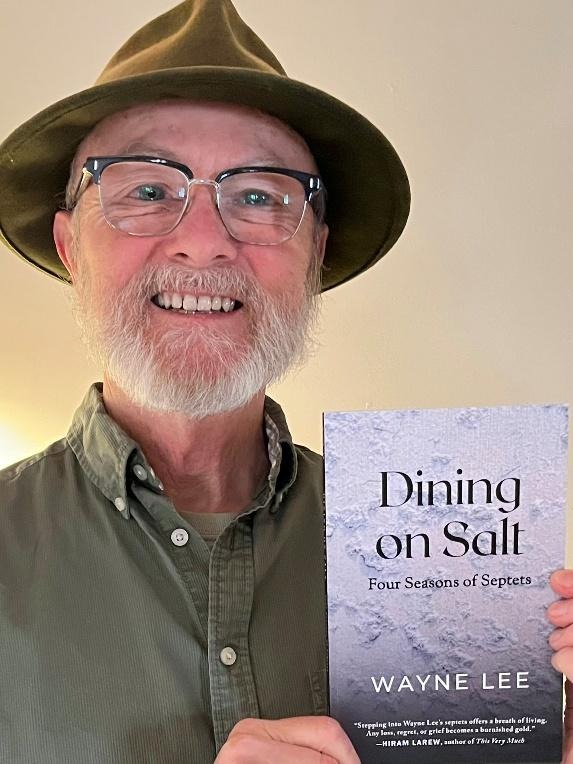
Wayne Lee, winner of the 2026 PSV North American Poetry Book Award for his book, Dining on Salt: Four Seasons of Septets, is a Santa Fe, New Mexico, writer, editor and teacher. His poems have appeared in Tupelo Press, Slipstream, The New Guard, Writer’s Digest, and other journals and anthologies. Lee also received the 2012 Fischer Prize, and he has been nominated for a Pushcart Prize and four Best of the Net Awards. His collection The Underside of Light was a finalist for the 2014 New Mexico/Arizona Book Award, and his collection The Beautiful Foolishness was published by Casa Urraca Press in March, 2026. Lee is the host of the online Tuesday Poetry Practice community.
Learn more about him and his work by visiting wayneleepoet.com.
Visit also Cornerstone Press for information about Cornerstone Press.
Mattie Quesenberry Smith, Ph.D., Poet Laureate of Virginia, has this to say about Lee’s winning collection:
In “Sunlight: A Shanzi,” a poem for Alice Rose Lee (1952-2018), Wayne Lee writes, “My wife takes her / life and an angel / suddenly appears. / I kiss her, then / she too flies off. / Blinding sunlight, / then the darkest night.” Of course, it is impossible for this poet to disclose what happens to him within “the darkest night.” Likewise, it is impossible for his readers to imagine him “[d]ining / on salt, on / all that is left / after the sea has dried up.” However, one heptastich at a time, Lee’s collection frames a seedbed for wisdom and kinship with his readers, and because he is an excellent poet, his readers want to remain seated with him at the dinner table, “as he stares at her chair.” Lee’s His readers choose to abide with him in an unforeseen, conflicted place where “there’s tomorrow, / a day that never ends.” Lost and found again throughout four seasons, riddled by exhales and inhales, darkness and light, this poet learns to fearlessly state, “Each of us is born one loss at a time.” This collection allows the poet to search through sky and earth, high and low, all the while, trusting he will be found someplace amid darkness, dirt, seed, root, stem, leaf, and sun. As he yields to each poem’s uniquely formal constraints, he discovers, “We take what we are given / and make do with what we have, attuned / to something beyond what we can hear.” Sometimes caught teetering on the edge of too much yearning “for the kiss of seasoning, / for sea salt, rosemary, peppercorns, lemon thyme,” Lee remembers to follow a “need for what lies beneath.” Encouraging his readers “that there is always more than we can see,” Dining on Salt explores unspeakable groans where one man’s faith transforms groans and syllables into septets. Each operates like horizontal window blinds that slide open just enough to let a useful balance of light and darkness pour onto the page, allowing the poet and his kin to imagine a jagged, broken world where a woman drops a teacup, yet the “teacup shatters / on stone tiles and gets / filled with tea.” This is a world where the reader accepts the poet’s invitation to “[l]et the wind rock you / like a cradle of bones / so you may know how it feels,” and then, “[s]ing to me while you still have / the words.”
The judge also selected the following books as First and Second Finalists:
First Finalist: Invited to the Feast by Bonnie Naradzay (Slant Books)
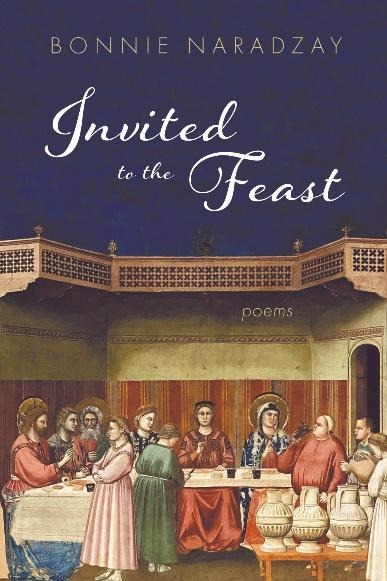
Bonnie Naradzay is the author of Invited to the Feast (Slant Books, 2025). Her poems have appeared in AGNI, Birmingham Poetry Review, Cider Press Review, The Georgia Review, Cumberland River Review, Dappled Things, New Letters, Poet Lore, Rhino, Anglican Theological Review, and many other journals. While at Harvard University’ graduate program, she was in Robert Lowell’s class on “The King James Bible as English Poetry.” In 2010 she won the University of New Orleans Poetry Prize (a month’s stay in the South Tyrol castle of Ezra Pound’s daughter Mary). Three of her poems have been nominated for a Pushcart prize. A 2017 graduate of the St John’s College Graduate Institute, she has led poetry classes at the DC Women’s Jail and currently leads weekly poetry sessions at Street Sense and at a retirement community, both in Washington, DC.
Learn more at Bonnie Naradzay.
Mattie Quesenberry Smith, Ph.D., Poet Laureate of Virginia, has this to say about Bonnie Naradzay’s first finalist collection, Invited to the Feast
Each poem in Invited to the Feast offers a delightful banquet of words that windows truths near apparent for anyone who wants to read and reason alongside Bonnie Naradzay, a poet so deeply rooted in the world’s classics that she intuits a universal need in storytelling people: the need to share a peaceful communion beyond what words can describe. This is Naradzay’s first poetry book, and her poems completely resonate because she has waited for the right time for them to cohere. Born in the mid-forties, she fills her poems with a long life of keen observations and interconnected, lightning-speed epiphanies. Holding them in retrospect, she sees these insights as pieces of an invitation, flagging her way to the feast. A wanderer, caught up in the chaos of the 1960s and lost within myriad mythologies fraught with dark and unfamiliar currents, a little like Homer’s Odysseus, she reifies experiences that tendered her heart and revived a mind wizened by nihilism and ennui. In “Summer of Love,” she says, “[b]y summer’s end, there was nothing we believed in,” “And I have told you this to make you grieve.” This poet’s tender and witty writing expands her readers’ insights about family and neighbors whom she has learned to love. She interweaves classical historical discourses with simple, innocent conversations from writers attending the poetry workshops she holds in day shelters, women’s prisons, and nursing homes. She shares fragments of conversations that remain after her family shatters. Throughout, the reader learns a better way to listen and love. Surprising birds arrive and perch within this book’s lines. Then, they fly away, little hints that somewhere, someone left a window open. In the end, the reader cannot doubt who is invited to the feast—anyone who grows weary and cannot find a place to rest. It is Eugenia in the poem “Paradise in the Day Shelter,” who recognizes “a slice of onion is heaven on earth.” In “Bede’s Sparrow,” it is “Carl, who sleeps / near the M Street Bridge” because he already knows “he likes how the shadows / of birds’ wings pass over his heart.”
Second Finalist: The Role of the Moon by D. S. Martin (Paraclete Press)
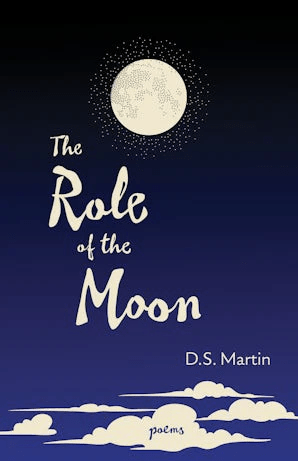
D.S. Martin is the author of six poetry collections, including Angelicus (2021), Ampersand (2018), & Conspiracy of Light: Poems Inspired by the Legacy of C.S. Lewis (2013) — all from Cascade Books. He is Poet-in-Residence at McMaster Divinity College, the Series Editor for the Poiema Poetry Series, and has recently edited two anthologies — The Turning Aside: The Kingdom Poets Book of Contemporary Christian Poetry (2016), and Adam, Eve, & the Riders of the Apocalypse (2017). D.S. Martin is also known for his blog, Kingdom Poets, and the web journal Poems For Ephesians. He and his wife live in Brampton, Ontario; they have two adult sons.
Learn more about D.S. Martin.
The Role of the Moon may be purchased at Paraclete Press.
Mattie Quesenberry Smith, Ph.D., Poet Laureate of Virginia, has this to say about D. S. Martin’s second finalist collection, The Role of the Moon
Imagine a poet brave enough to uphold the metaphysical canon and stitch together metaphysical poetry throughout the ages as a constructive part of that poet’s meditation and creative process. Imagine a poet willing to resist the “hidden impulse to leave his mark” in order “to connect all that’s gone before with what is yet to come / perhaps suggesting that although we’re bent & all so twisted / & stuck in the now that that not be / the final word” Yes, D. S. Martin omits a period at the end of “the final word” in the poem “Another Ampersand (+&”)” which opens his seven-section poetry book, The Role of the Moon. Throughout his poems, he invites readers to wonder about the power of grammar and punctuation to control the dance between meaning and uncertainty across the page. Martin has erased periods and commas throughout these poems, but he adds space between words and phrases as well as ampersands and question marks. By doing so, Martin demonstrates on the typographical level that want and uncertainty motivate his open-ended metaphysical journey. He hearkens to precedent metaphysical poets as he confronts aspects of God and the universe that escape what he knows. These doubts kindle a yearning like the yearning people feel when they see the moon. His strategies discipline him and his readers to turn away from rumination, self-absorption, and short-sighted conclusions, so they can recognize other poets throughout history also wrestled deep doubts and yearned for what remains outside of themselves and their capacity for “saying.” Martin’s poems argue that metaphysical poetry bridges what people think they understand and what they desire to understand. The metaphysical impetus is a faithful impetus: as metaphysical poets search the universe, they believe someone exists who recognizes them, someone willing to share answers. However, whether the person is a scientist or a poet, this paired recognition hinges on the person’s faith and confidence to confess ignorance and embrace humility. People who yearn for Truth seek, even though meaning and truth slip away through the interstices of language. However, somewhere at its exigence, yearning, once acted on, engenders satisfaction and peace. Inspired by David Attenborough in a BBC documentary about “the instinct the newborn ibex get,” Martin says, “There are two types / of ibex those who thirst for the water / a thousand feet down & those already drinking.” In The Role of the Moon, Martin suggests the metaphysical poets have been drinking water “a thousand feet down.”
We are pleased to recognize the following six semifinalists, in alphabetical order (by author), as well:
Susan Browne, Monster Mash (Four Way Books)
Holli Carrell, Apostasies (Perugia Press)
Latorial Faison, Nursery Rhymes in Black (University of Alaska Press)
Silas House, All These Ghosts (Blair)
Richard Jones, Passport (Green Linden Press)
Gabrielle Myers, Pointsa in the Network (Finishing Line Press)
Our profound thanks to this year’s final judge, Mattie Quesenberry Smith, and to our devoted preliminary judges. Our deep gratitude as well to all the authors and publishers who entered this year’s competition, providing the judges with many hours of reading pleasure and the unenviable task of having to select only one book as First-Place winner from among many excellent works.
Sofia M. Starnes
Chair, 2026 Poetry Society of Virginia North American Poetry Book Award
2025 PSV NORTH AMERICAN POETRY BOOK AWARD Winner
The Poetry Society of Virginia is pleased to announce the Winner of the 2025 PSV North American Poetry Book Award Apocryphal Genesis by Travis Mossotti (Saturnalia Books)
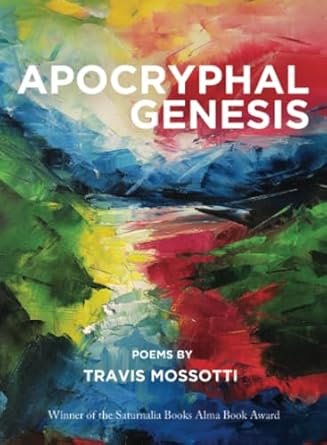
Travis Mossotti, winner of the 2025 North American Poetry Book Award for his collection Apocryphal Genesis (Saturnalia Press), is the author of several award-winning works, including About the Dead, Field Study, Narcissus Americana, and Racecar Jesus. He has been the recipient of the Miller Williams Poetry Prize and the May Swenson Book Award, among other commendations. He serves as a Biodiversity Fellow for the Living Earth Collaborative at Washington University. He lives and works in St. Louis.

Thomas Gardner, Professor Emeritus, Virginia Tech, this year’s PSV North American Poetry Book Award final judge, praised Mossotti’s work as follows:
“Apocryphal Genesis is an act of witness, committed to peering through the mists of time and dailiness and bringing back into speech the invisible and forgotten. It’s a book “shin[ing] lights / on daily happenings of negligible / import,” convinced, and seeking to convince us, that this is where the sacred resides and where the cosmos holds its secrets. “Only invisible things are worth weeping for” it tells us, fighting to bring the world back into focus by uncovering old wounds and singing its way back into “the anger of the discarded” or “the rougher art” of our daily attempts to make meaning and perhaps, for a moment, if only a moment, “hang / an image upon the dining room wall / where before there was nothing, until now.” Its way is the way of meandering, as if what matters and what must be said can only be discovered in the saying, the poet’s deep faith in the everyday and ordinary supported by an equally deep faith in language’s ability to take us there. “We need not depart with an arrival in mind / as we sift our way through language,” Mossotti writes, sure that in time, in the writing, it will be morning again, “each step forward / [having] brought the world that much more into focus.” This is an exquisite, soaring book, catching thought on the fly, tasting it on the tongue before it “dissolves like sugar into batter” or standing back as it shatters in the air and reforms.”
First Finalist: In Another Country by Andrea Jurjević (Saturnalia Books)

Andrea Jurjević – Saturnalia Books
“These are poems, Jurjević writes, unfolding the space “between song and suffering [where] there is only nimble weather, bodies wet / with meaning.” And how powerfully the body speaks here, hungry, displaced, aroused, a palimpsest of tracings and visions and scars. If history’s unspeakable weight cannot be fully spoken, then, these poems insist, “what we keep unsaid we taste on our tongues,” in a language of the dark, “wet and light-absorbing,” making out of silence “a wild wasting,” a “gnawing for more,” “a stillsong” vividly present, winding its way through poem after poem.”
Second Finalist: Cauterized by Laura Apol (Michigan State University Press)

Book Details – Michigan State University
“Indeed, these poems are cauterized, “seared,” Laura Apol writes, by the death of a daughter, by “the grief / of a heart that once grew inside me, her / breaking.” Unsettled, self-lacerating—“Why didn’t she tell me?,” one poem asks; “Are you happy now? / See what you made me do?” laments another—these poems refuse consolation, refuse silence, refuse to be mended. And yet somehow, in that grief, out a language simultaneously wounded and tender, they teach us to make, with her, “a home for them,” for all of our losses.”
2025 Semifinalists
- Daughter of Three Gone Kingdoms by Joan Kwon Glass (Perugia Press)
- Inheritance with a High Error Rate by Jen Karetnick (Cider Press)
- The Intimacy of Spoons by Jim Minick (Madville Publishing)
- Four Fields by Dorinda Wegener (Trio House Press)
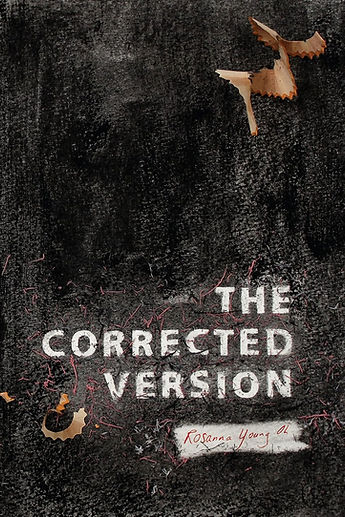
2024 North American Poetry Book Award Winner
The Corrected Version by Rosanna Young Oh
“The spine of this remarkable debut collection is a series of poems about a speaker’s immigrant family and a childhood spent as the daughter of a Korean-born grocer who himself values reading and once wrote poems, but who now pours his lifeblood into keeping his store open 24/4 in the new world of America in which he has transplanted his family.
In poems by turn intergenerational, mythic, historical, personal, and ekphrastic, The Corrected Version offers the reader a revised look at an experience of immigrant life that is often misunderstood or oversimplified. In the opening poem, ‘Homework,’ a sonnet, a girl is praised by her teacher for writing with fresh detail about her home life and is encouraged to share her work with her classmates. When she does so, a boy’s cruel laugh ‘cuts me through,’ and the speaker wonders ‘Should I pretend my stories aren’t true?’ This book’s sensory, unflinching, gorgeously restrained poems offer the poet’s bold answer to this question.”
Lisa Russ Spaar, PSV North American Poetry Book Award final judge on The Corrected Version
2024 First Finalist
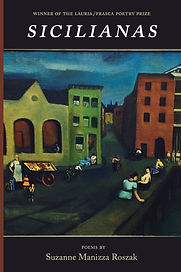
Siciliananas by Suzanne Manizza Roszak (Bordighera Press)
“This inaugural collection is haunted by a host of twentieth-century Sicilian immigrants, mostly women, whose experiences, stories, and histories are given voice…In the title poem, the speaker says, ‘Today I’ve been in the mood for telling other people’s stories.’ And tell she does, in poems both evocative and mysterious. And yet the poems are not just about the globally dispersed lives of others; as she sings for those who often did not have a voice, she also comes to better know herself…” Lisa Russ Spaar, NAPBA Final Judge 2024
2024 Second Finalist
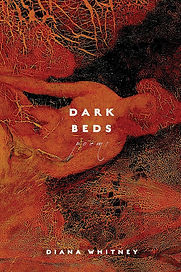
Dark Beds by Diana Whitney (June Road Press)
“Whitney’s rich, sensual, formally deft and often erotic poems of transgression and fidelity in realms domestic and beyond remind us that there is always a place in the Zeitgeist for the lyric poem of interiority and beauty. Whether delivering snacks to hungry first-graders and then rushing home to vacuum glow-in-the dark stars from the Berber carpet or swooning over ‘rapture without consequence,’ this is a speaker who turns again and again to the natural world for its lessons of indifference and transformation…” Lisa Russ Spaar, NAPBA Final Judge 2024
2024 Semifinalists
- Something So Good It Can Never Be Enough by Shuly Xóchitl Cawood, Press 53
- Below Zero by Carol V. Davis, Stephen F. Austin State University Press
- The Long Journey Out by Ronald Okuaki Lieber, Resource Publications
- The Disordered Alphabet by Cintia Santana, Four Way Books
- The Boneheap in the Lion’s Den by Maya J. Sorini, Press 53
- Local Congregation by Phillip Sterling, Main Street Rag Publishing Company
- Heaven Underfoot by Diana Woodcock, Codhill Press
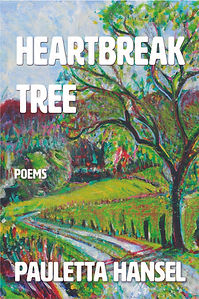
2023 North American Poetry Book Award Winner
Heartbreak Tree by Pauletta Hansel
Bill Glose, PSV North American Poetry Book Award final judge, praised Pauletta Hansel’s winning collection:
“Even before we open this book, the title warns what lies within will be bittersweet, its Heartbreak Tree rooted in ground seeded with regret and unfulfilled desires (When hurt is all that’s handed down / you learn to claim it). Yet, these poems also luxuriate in the comforts and personal connections that only home can offer, “the unseen river that silvers / through our dreams.”
The early poems serve as a captivating reminiscence that transports the reader to hardscrabble life in rural Kentucky (What people in town remember about my family’s home / was the dirt in the fenced front yard where no grass / could stay grown). But as the book progresses, the poems settle into middle-aged reckoning and acceptance, often told via letters the author writes to her 15-year-old self (If we are skin, you are peeled bark of sycamore long gone from / me. If we are bone, you are always mine).
Pauletta Hansel delivers a rust-edged nostalgia that portrays both a life of wistful yearnings and an acceptance of limitations, an ever-present dichotomy that leaves her examining most things from multiple angles (What moves us onward is the same, / sometimes, as what breaks us to the ground). The skill with which she traverses this seeming contradiction makes this captivating collection a must read.”
2023 First Finalist
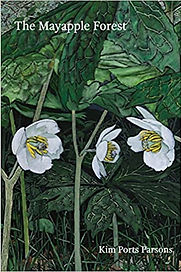
The Mayapple Forest by Kim Ports Parson (Terrapin Books)
“Beautiful, evocative, mournful, Suzanne Edison’s poetry plumbs the depths of personal grief. In verse that often plays with form on the page, where much can be inferred from the white space between words, these poems stretch beyond their lines and entice readers to return for a second reading to glean deeper meanings.” Bill Glose, NAPBA Final Judge
2023 Second Finalist
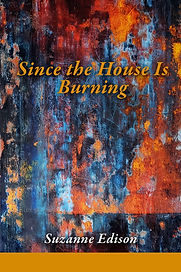
Since the House is Burning by Suzanne Edison (MoonPath Press)
“These plain-spoken poems present a love song to life and all its daily miracles, often reveling in the splendor of the natural world. There are lamentations here, too, but the overall sense one gets from reading Kim Ports Parsons’ luminous collection is that the world is full of hope if only we open our minds to the possibility.” Bill Glose, NAPBA Final Judge
2023 Semifinalists
- House in Need of Mooring by Libby Bernardin, Press 53
- White Bull by Elizabeth Hughey, Sarabande Books
- Bodies of Time and Space by Glen A. Mazis, Kelsay Books
- Dear If by Mary B. Moore, Orison Books
- Door to Remain, by Austin Segrest, Univ. of North Texas Press
- Monologue of Fire by Samuel Ugbechie, New Rivers Press
Other Past NAPBA Winners and Finalists
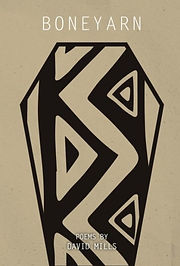
- Boneyarn by David Mills, 2022 Winner
- A Fine Yellow Dust by Laura Apol, 2022 First Finalist
- Anything That Happens by Cheryl Wilder, 2022 Second Finalist
- Kontemporary Amerikan Poetry by John Murillo, 2021 Winner
- The Museum of Small Bones by Miho Nanaka, 2021 First Finalist
- And So Wax Was Made & Also Honey by Amy Beeder, 2021 Second Finalist

Other Past Semifinalists
2022 Semifinalists
- Wasteland Honey by Robert Clinton
- At the Bottom of the Year by David Craig
- Sweetgum & Lightning by Rodney Terich Leonard
- Dolls by Claire Millikin
- Flying Yellow by Suzanne Rhodes
- Somewhere to Follow by Paul Willis
2021 Semifinalists
- Arrows by Dan Beachy-Quick
- Americana Motel by Stephen Benz
- Took House by Lauren Camp
- Drowning in the Floating World by Meg Eden
- Dense Poems & Socratic Light by John Martin Finlay
- Devil’s Lake by Sarah M. Sala
- Arena by Lauren Shapiro
 Poetry Society of Virginia